Décor Changes You Can Finish
When you have already cleared the surfaces and tuned the furniture placement, a room needs only one or two honest material details to feel settled. We avoid trendy faux-finishes or disposable peel-and-stick plastics. Instead, focus on the touchpoints your hands and eyes encounter every day: weighty cabinet hardware, warm 2700K lighting, properly hung frames, and well-proportioned drapery.
Replacing Hollow Cabinet Pulls with Solid Brass or Cast Iron
Flat-pack dressers and builder kitchen cabinets often cut corners on hardware, installing lightweight plated pulls that loosen every month. Swapping them for unlacquered brass, oil-rubbed bronze, or turned oak knobs takes less than an hour and changes how every drawer feels in your hand.
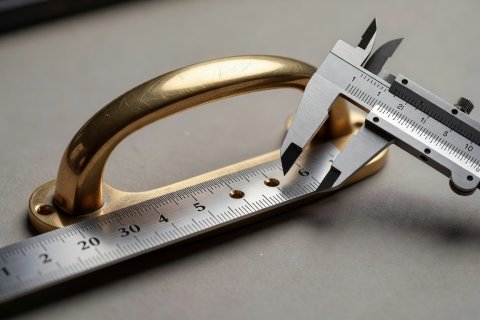
The Center-to-Center Rule
Remove one existing handle and measure from the exact center of the left screw hole to the exact center of the right screw hole. Standard North American sizes are 3 inches (76mm), 3-3/4 inches (96mm), and 5 inches (128mm). Match this number so you never have to drill or patch cabinet faces.
- Measure Drawer Front Thickness: Most cabinet doors are 3/4 inch (19mm) thick, while drawer boxes with false fronts can be 1-1/4 to 1-1/2 inches thick. Buy break-away #8-32 machine screws and snap them to length with lineman’s pliers.
- Add Finish Washers (Backplates): If the old knobs left an indentation or paint ring on the wood, slip a 1-inch brass rosette or flat washer behind the new knob to conceal the mark cleanly.
- Use a Drop of Threadlocker: Put a tiny dab of removable blue threadlocker (or beeswax) on the machine screw threads so single-post knobs never spin loose when pulled.
Plug-In Wall Sconces & The 2700K Bulb Standard
A single overhead ceiling fixture casts harsh downward shadows and makes a living room or bedroom feel like an office after dusk. Aim for three points of eye-level warmth in every living space, using consistent color temperatures.
Banish Mixed Daylight Bulbs
Check the printed base of every LED bulb in the room. Replace any 4000K (cool white) or 5000K (daylight blue) bulbs with 2700K Warm White bulbs rated at 90+ CRI (Color Rendering Index). High-CRI 2700K bulbs render wood grain, linen textiles, and wall colors rich and natural rather than washed-out grey.
Mounting Plug-In Sconces Cleanly
Mount plug-in reading sconces so the bottom of the shade sits 48 to 52 inches above the floor (just above seated shoulder height). Enclose the hanging fabric cord inside a 1/2-inch paintable D-profile cord cover adhered vertically alongside the bed frame, brushed with two coats of your exact wall paint.
The 57-Inch Picture Centerline & Wide Curtain Brackets
Two common habits make rooms feel unintentionally disjointed: hanging artwork way too high near the door header, and mounting curtain brackets directly onto the narrow wooden window casing so the fabric blocks 30% of the glass.
- Use the Museum 57-Inch Formula: Measure 57 inches up from the floor—average human eye level—and mark lightly with a pencil. Measure the total height of your picture frame, divide by two, subtract the slack distance from the top of the frame to the taut hanging wire, and drive your picture hook at that exact spot.
- Extend Curtain Rods 8 Inches Past the Trim: When hanging drapery rods, set the brackets 4 to 6 inches above the top window casing and 8 to 10 inches wider than the side trim on both left and right. During the day, the linen curtain stack rests against the drywall beside the window, exposing 100% of the glass pane.